Oxford ELLT Digital – English Level Test Online
The Oxford ELLT (English Language Level Test) is a fully online test that allows you to assess your English proficiency from the comfort of your home — with the same security standards as a traditional test center.
This test is ideal for students planning to study abroad or professionals who need certified English language credentials for work or education.
| ✅ Key Features | Details |
|---|---|
| 100% Online | Take your test from anywhere, even with low internet speeds (5Mbps). |
| Flexible & Convenient | Schedule the test on a date that suits you — no travel required. |
| Fast Results | Receive your results within 48 hours after completing the test. |
| Secure | Uses AI proctoring and advanced anti-fraud measures to ensure test integrity. |
| Free Learning Resources | Access a range of preparation materials to help you succeed. |
| Worldwide Acceptance | Recognized by universities and employers globally. |
| Official Certification | Get a certified test result issued by Oxford International Digital Institute. |
| 💰 Price | £120.00 |
📊 Trusted Evaluation by Ecctis
The Oxford ELLT has been reviewed independently by Ecctis and confirmed to provide a sound assessment of CEFR levels B1 to C1 across:
- Listening
- Reading
- Writing
- Speaking
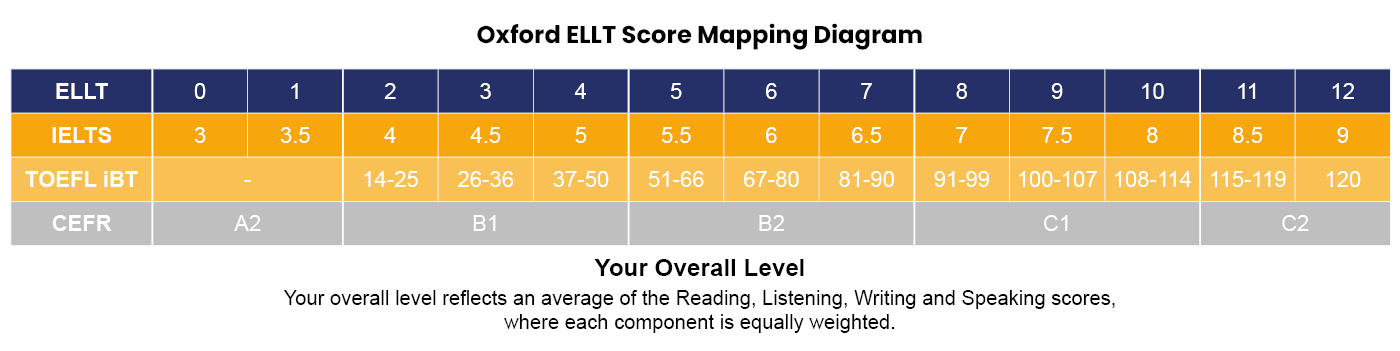
Oxford ELLT Score Mapping Diagram
This validation ensures the test meets international standards for English language competency.
📝 Test Components
- Pre-Test Set Up As part of the pre-test setup in every part, you’ll need to take a clear photo of yourself, a photo of your passport, and a photo holding your passport. You’ll also be asked to share your screen, complete a 360° video scan (which can be prompt in mid-way of your test), and check your internet speed and volume level.
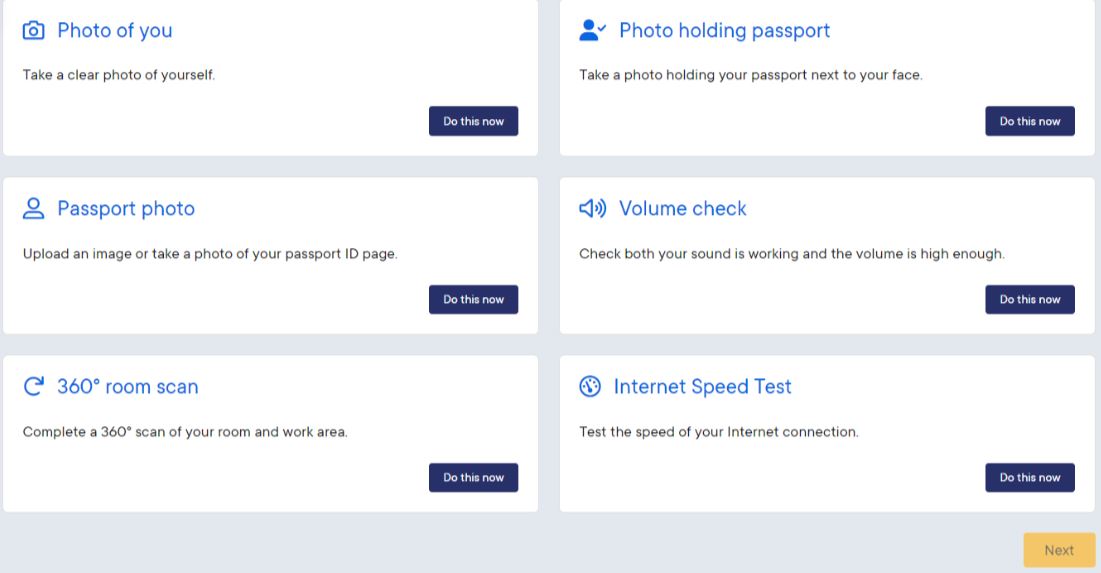
Oxford ELLT Pre-Test Set Up Schema
-
Writing
- The writing test lasts 45 minutes.
- You will complete one essay question and must write between 190 and 260 words.
- Your writing test is marked by the same examiner who will conduct your speaking test (section four).
-
Listening
- During the listening test, you will hear three different audio tracks:
- Monologue (played once)
- Dialogue (played twice)
- Listening Analysis (played twice)
- There are 28 questions in total.
- You have 25 minutes to complete the listening test.
-
Reading
- The reading test lasts 40 minutes.
- You will answer 32 questions based on two different reading texts (16 questions per text).
-
Speaking
- The speaking test is broken down into four sections and lasts approximately 30 minutes:
- Section one (unassessed): Introduction. Your examiner will ask you a couple of introductory questions and ask you to confirm your identity.
- Section two: Presentation task. You will be required to present on the given topic for 3–5 minutes.
- Section three: Based on the writing test. Your examiner will ask you questions relating to your written answer, such as your choice of vocabulary or the ideas you wrote about.
- Section four: Examiner-led discussion based on a visual prompt. Your examiner will show you an image for 15 seconds and lead a discussion based on the image. You should attempt to speak freely about the given image. oellt-speaking-test-task-stages
- The speaking test is broken down into four sections and lasts approximately 30 minutes:
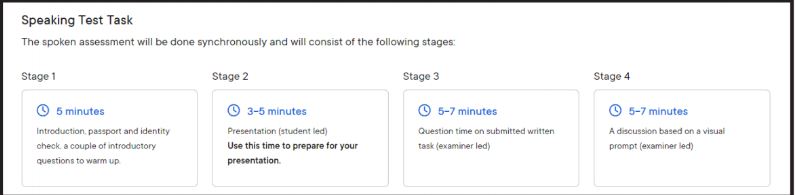
Oxford ELLT Speaking-Test Stages
🗣️ Starting Your Speaking Test
Before starting your Oxford ELLT Speaking test, you will receive 15 minutes of preparation time. During this time, you will be shown the test structure and the presentation topic you will need to present. Please use this time to prepare before joining the Zoom meeting.
For example, if your test starts at 14:00, the Stage 2 question and test instructions will appear on your dashboard like this. You will then have 15 minutes to prepare, during which video and audio recording will not be active. Once the 15-minute countdown ends, a pop-up saying “Open Zoom Link” will appear on your dashboard. It is very important that you join the Zoom meeting promptly at that time.
Note: Your Zoom username must exactly match your real name as it appears on your passport.
Zoom will launch the meeting, which can be opened through the Zoom application or in an internet browser. At this point, you will meet with an Oxford ELLT Examiner who will take you through the four sections of the Oxford ELLT Speaking test.
Once the 15-minute preparation time has ended, you will be asked to join the Zoom meeting automatically. To do this, click ‘Open Zoom call’.
OELLT - Sample Questions for Speeaking Part
Stage 1: Introduction
- Can you tell me your full name, please?
- Where are you from?
- What is your job/work?
- Where do you work?
- Do you enjoy your work?
- Why you are giving Oxford ELLT test?
- What are you studying?
- Where do you study?
- why you want to study in UK?
- Is there any particular reason why you chose that course?
- Where is your home?
- Who lives with you at home?
- Is there anything in particular that you like about your home?
- Is your neighborhood good?
- What is your favorite food?
- Do you consume unhealthy food?
- Do you cook?
- Can you describe your hometown?
- What is your favourite hobby or pastime?
- Do you prefer spending time indoors or outdoors?
- How do you usually spend your weekends?
- Do you have any pets?
- What kind of music do you enjoy listening to?
- Do you play any musical instruments?
- Are you more of a morning person or a night person?
- What is your favourite season of the year?
- How do you usually get to work or school?
- Do you prefer travelling by car, train, or plane?
- Have you travelled to any foreign countries?
- What type of places do you like to visit when you travel?
- Do you like reading books? What kind of books do you enjoy?
- Do you watch movies or TV shows? What is your favourite genre?
- What is the last movie you watched?
- How often do you exercise?
- Do you follow any sports? What is your favourite team?
- Are you good at managing your time?
- How do you usually start your day?
- Are you close to your family members?
- What is your favourite thing to do with your friends?
- What’s the best vacation you’ve ever had?
- Do you like trying new food from different cultures?
- Have you ever done any volunteer work?
Some Example of Introduction Section
Q-1: Do you hear me or can you hear me?
Answer: Yes, I do hear you/Yes I can hear you.
Q-2. What’s your name?
Answer: My name is…… and you can call me……
Q-3. Can I see your ID please or do you have ID?
Answer: Sure, here it is…….
Q-4. Hold on, don’t move, can I see front of passport,
Answer: ok.
• Q-4. How are you?
Answer: I am great thanks, how about you?
TIPS: ✅ Be clear and complete (Give full answers, not just one word), 😊 Smile and stay calm (This part is not graded, relax and be natural), 🗣️ Speak in full sentences (Avoid short replies like “student” – say “I am a student.”), 🎯Answer what is asked (Stay focused and respond directly to the question), and ➕ Add a detail if possible (Extra details show fluency and confidence).
Stage 2: Presentation
Prepare effectively for the OELLT speaking presentation task with this structured, step-by-step guide designed to build your confidence and fluency.
- 🛠️ Preparation Rules & Format
- ⏳ You’ll have 15 minutes to prepare your response before speaking.
- 📝 You may use brief notes (bullet points only) to support your delivery.
- 🚫 Do not read directly from your notes during the presentation — speak naturally.
- ⚖️ When beginning a presentation, always start with a greeting, then say: “Now, I will begin my presentation.” To conclude, use: “Thank you for your attention!”
- 🗂️ Recommended Note Structure
Use the format below to organize your thoughts clearly and quickly:
-
Topic: [Insert topic here]
- Advantages / Positive Aspects:
- Point one
- Point two
- Point three
- Disadvantages / Negative Aspects:
- Point one
- Point two
- Point three
- Personal Opinion or Insight (Optional):
- Reflective thought
- Real-life connection
- Conclusion:
Summarize your key points or give a closing remark
- 🔁 Practice Strategy to Improve
Follow these steps consistently to strengthen your speaking performance:
-
Plan Your Notes
Use the structure above to prepare a new topic daily. -
Write a Full Version
Expand your notes into complete sentences to form a full speech. -
Practice Without the Script
Hide your full text and rehearse using only your bullet points. -
Record Yourself
Use your phone or laptop to record your spoken version. -
Review & Reflect
Play back your recording and ask:- ⏱️ Did you stay within the time limit?
- 🗣️ Was your speech smooth and natural?
- ✅ Did you cover all key points accurately?
- 💬 Did you sound confident and engaging?
Tips: 💪 The goal is to sound natural, clear, and confident — not perfect. Regular practice using this method will help you deliver strong, well-structured presentations under time pressure.
-
Sample Presentation Template: You can change it or create similar many templates
  - Introduction
  Hello Greetings,

  Now, I will begin my presentation.  Today, I’ll be speaking about {Topic}, a subject that affects many of us in different ways.

  - Overview
  This topic brings out various perspectives. Some believe it brings major benefits, while others are more cautious due to possible challenges. In this presentation, I’ll explore both sides, share some examples, and conclude with my personal view.

  🟢 Advantages / Positive Aspects

    1. {First Advantage}
    This is important because...
    Example: For instance,...

    1. {Second Advantage}
    Another reason is...
    Example: A good example is...

    1. {Third Advantage}
    Additionally,...
    Example: For example,...

    🔴 Disadvantages / Challenges

    1. {First Challenge}
    One concern is that...
    Example: For example,...

    2. {Second Challenge}
    Another issue is...
    Example: Such as...

    3. {Third Challenge}
    Finally,...
    Example: A case in point is...

    💬 Personal Reflection

    Considering both sides, I personally (agree/disagree/partly agree) with the idea of {Your Position}.
    I believe this because... (give a reason or insight).

  🧭 Conclusion

  To wrap up, we’ve looked at the pros and cons of {Topic}. While it offers many opportunities, it also raises valid concerns. The best way forward may depend on how these issues are managed.

  Thank you for your attention!
Presentation: Sample Questions
Topic: In order to stop the problem of food insecurity (i.e. not having enough food due to high prices), children should receive meals at schools. This plan should be paid for by the government. (Source: The Globe & Mail). In your opinion, what are the advantages and disadvantages of providing school meals to children in need?
🗂️ Note Structure
-
Topic: Providing government-funded school meals to tackle food insecurity
-
Advantages / Positive Aspects:
- Improves children’s health and nutrition
- Enhances academic performance and attendance
- Reduces financial stress for low-income families
-
Disadvantages / Negative Aspects:
- High financial burden on government budgets
- Risk of over-dependence on public aid
- Management issues – quality control and food waste
-
Personal Opinion or Insight (Optional):
- Investing in children’s health and education pays off long-term
- Government support is essential for breaking the poverty cycle
-
Conclusion: While the program has financial and logistical challenges, its benefits to children, families, and society make it a necessary and worthwhile investment.
Presentation
Hello Now, I will begin my presentation.

Today, I’ll be speaking about a topic that directly affects many children and families around the world — **providing government-funded school meals as a way to address food insecurity**.

Food insecurity, which means not having consistent access to enough food due to high prices or poverty, is a serious and growing issue in many countries. One proposed solution is for governments to provide free meals in schools, especially for children from low-income families. This idea has received both strong support and some criticism. In this presentation, I’ll explore both sides and share my personal view at the end.

🟢 First and foremost, **school meals improve children's health and nutrition**. When students receive regular, balanced meals at school, it helps with their physical development and prevents hunger during the school day.
Second, **it enhances academic performance**. Well-fed students are more focused and energized, leading to better concentration, higher attendance rates, and improved learning outcomes. For example, studies in Finland show that students who have access to school meals tend to perform better overall.
Third, **it reduces financial pressure on families**. Many parents struggle to provide three full meals a day. Offering meals at school means families can save money and use their limited income for other basic needs like housing or healthcare.

🔴 However, this plan also comes with challenges. The biggest concern is **the financial burden on the government**. Running a national school meal program is expensive and may require raising taxes or reducing budgets in other important sectors like healthcare or infrastructure. Another issue is the **risk of long-term dependence**. Some argue that continuous free services may discourage families from becoming financially self-reliant or from seeking other solutions to their struggles. Finally, **implementing and managing these programs is not easy**. If not properly handled, they can result in poor food quality, excessive food waste, or corruption in the system. In some countries, poorly managed meal programs have failed to meet nutritional standards and lost public trust.

💬 Despite these drawbacks, I **strongly support** the idea of government-funded school meals. I believe it is a meaningful investment in children’s well-being and their future. When students are healthy and focused, they learn better and grow into productive members of society. This is not just an education issue, but also a social and economic one. Moreover, for many families, this kind of support is a lifeline that helps them stay afloat during difficult times. And if programs are well designed, the risks can be managed.

🧭 To conclude, **providing free school meals** comes with financial and logistical challenges, but the benefits — better health, better learning, and stronger family support — make it a powerful solution to tackle food insecurity. I believe it is a step toward creating a more equal and supportive society.

Thank you very much for your attention.
>>> Now you can follow similar steps: read the question, prepare notes using the recommended format, write your presentation, review it, and then practice delivering it naturally while referring to your notes.
- ❓Topic: Consider the challenge listed below and prepare a short presentation on the topic: People around the world enjoy watching sports for many different reasons (Source: psychologytoday.com ).
- What are the good things and bad things about watching sports. are there any sports that move entertaining to watch than others. Consider both side. Your presentation must:
- Include an argument in favour and an argument against
- Include a personal reflection
- Be between 5 – 6 minutes long.
- What are the good things and bad things about watching sports. are there any sports that move entertaining to watch than others. Consider both side. Your presentation must:
- ❓Topic: Consider the challenge listed below and prepare a short presentation on the topic: “People around the world enjoy watching sports for many different reasons.” (Source: psychologytoday.com)
- What are the good things and bad things about watching sport? Are there any sports that are more entertaining to watch than others? Consider both sides and give a personal opinion based on your own experience. Your presentation must:
- Include an argument in favour and an argument against.
- Include a personal reflection.
- Be between 3–5 minutes long.
- What are the good things and bad things about watching sport? Are there any sports that are more entertaining to watch than others? Consider both sides and give a personal opinion based on your own experience. Your presentation must:
- ❓Topic: Consider the challenge listed below and prepare a short presentation on the topic:
- In 2021, 99% of primary schools pupils in Cyprus, spain poland and austria were learning english as a foreign language and 49.5% of all students in scondary schools were learning two or more languages. (Source:ec.europa.eu )
- In your opinion what are the two main benefits of studying a foreign language? what are the biggest challenges when learning a new language?
-
Your presentation must:
-
Include an argument in favour and an argument against
-
Include a personal reflection
-
Be between 5 – 6 minutes long.
-
- ❓Topic: Consider the challenge listed below and prepare a short presentation on the topic: There a trend of work is a pain, and i will just fit in around the rest of my life (Source: the Guardian ) many people believe that is important to love your job for it make you happy other believe your job only important so you can do other thing to enjoy life.
- Discuss both side of arguments. Your presentation must:
- Include an argument in favour and an argument against
- Include a personal reflection
- Be between 5 – 6 minutes long.
- Discuss both side of arguments. Your presentation must:
- ❓Topic: “The rise of artificial intelligence will lead to job losses in many industries” (Source: The Economist).
- What are the advantages and disadvantages of AI in the workplace?
- Do you think governments should regulate the development of AI?
- Discuss both side of arguments. Your presentation must:
- Include an argument in favour and an argument against
- Include a personal reflection
- Be between 5 – 6 minutes long.
- ❓Topic: “Banning single-use plastics is essential to save the environment” (Source: The New York Times).
- What are the benefits and challenges of banning single-use plastics?
- Do you think alternative materials are a practical solution?
- Discuss both side of arguments. Your presentation must:
- Include an argument in favour and an argument against
- Include a personal reflection
- Be between 5 – 6 minutes long.
- ❓Topic: “Online shopping is replacing traditional retail stores” (Source: Forbes).
- What are the advantages and disadvantages of shopping online compared to in-person shopping?
- Do you think retail stores will disappear in the future?
- Discuss both side of arguments. Your presentation must:
- Include an argument in favour and an argument against
- Include a personal reflection
- Be between 5 – 6 minutes long.
- ❓Topic: “The government should impose higher taxes on sugary drinks to improve public health” (Source: The Guardian).
- What are the pros and cons of introducing higher taxes on sugary drinks?
- Do you think this approach is effective in promoting healthier lifestyles?
- Discuss both side of arguments. Your presentation must:
- Include an argument in favour and an argument against
- Include a personal reflection
- Be between 5 – 6 minutes long.
- ❓Topic: “Remote work is here to stay” (Source: Harvard Business Review).
- What are the benefits and drawbacks of remote working for employees and employers?
- Do you think remote work should be encouraged in all industries?
- Discuss both side of arguments. Your presentation must:
- Include an argument in favour and an argument against
- Include a personal reflection
- Be between 5 – 6 minutes long.
- ❓Topic: “Fast food is very popular around the world even though it might not be the healthiest choice. (Source: WHO) What are some pros and cons of eating fast food?”
- Discuss both side of arguments. Your presentation must:
- Include an argument in favour and an argument against
- Include a personal reflection
- Be between 5 – 6 minutes long.
- Discuss both side of arguments. Your presentation must:
- ❓Topic: “Shoppers can now use their phones to buy products in-store. (Source: The guardian) What are the advantages and disadvantages of paying for things with phone? Do you prefer paying in this way? Why/Why not?
- Your Presentation must:
- Include an argument in favour and an argument against
- Include a personal reflection
- Be between 5 – 6 minutes long.
- Your Presentation must:
- ❓Topic: “Most people spend their weekends watching TV, going shopping, and cleaning their house.” (Source:dailymail.co.uk) What are the pros and cons of doing the same activities every weekend?
- Your Presentation must:
- Include an argument in favour and an argument against
- Include a personal reflection
- Be between 5 – 6 minutes long.
- Your Presentation must:
- ❓Topic: “Walking makes us healthier, happier, and smarter, and so walking is often seen as the perfect exercise. Some people, however, say that walking is not a proper exercise. (The Guardian) In your Opinion, what are the three main benefits of walking or exercise in general? Are there any disadvantages?
- Your Presentation must:
- Include an argument in favour and an argument against
- Include a personal reflection
- Be between 5 – 6 minutes long.
- Your Presentation must:
Stage 3: Essay
In this stage, the examiner will ask you questions about the essay you wrote in the Written Part of the OELLT. You may be asked to explain your ideas, clarify your arguments, or discuss your choice of vocabulary and examples. This is an opportunity to demonstrate your understanding of your essay and your ability to discuss your writing in English.
📚 OELLT Essay Preparation Guide
| Steps | Key Actions & Benefits |
|---|---|
| 1. Notebook Transcription ✍️ | • Try to remember entire essay as soon as exams ends and write into notebook • Creates personal reference material 📖 |
| 2. Vocabulary Boost 📖 | • Identify 100-120 difficult words • Learn: definitions 📝, synonyms/antonyms 🔄, example sentences 💬 • Expands lexical range for higher scores 🚀 |
| 3. Paraphrasing Drill 🔄 | • Rewrite essay in your own words • Develops fluency for speaking exam 🗣️ |
| 4. Summary Crafting ✂️ | • Condense to 100-120 words (key points only) • Sharpens concise writing skills ✨ |
| 5. Deep Comprehension 🔍 | • Analyze every sentence → clarify doubts ❓ • Ensures complete understanding 🧠 |
| 6. Critical Expansion 💡 | • Add 2-3 extra advantages/disadvantages • Demonstrates analytical thinking 🎯 |
+ potential Stage 3: Essay Discussion Questions for the OELLT Speaking exam, categorized by question type:
1. Content & Structure Questions
- “Can you summarize your essay’s main argument in 2-3 sentences?”
- “Why did you choose this specific thesis statement?”
- “How did you organize your supporting points? Walk us through your structure.”
- “Which paragraph do you think is the strongest? Why?”
2. Vocabulary & Language Use
- “You used the word [X] in paragraph [Y]. Why was this the best word choice?”
- “Find 3 advanced vocabulary words in your essay and explain their meanings.”
- “How could you rewrite this sentence using simpler words: [quote sentence]?”
- “What synonyms could replace [X] without changing the meaning?”
3. Critical Thinking & Analysis
- “If you had to add another example to support your argument, what would it be?”
- “What’s one counterargument to your position? How would you respond?”
- “How does your conclusion connect back to your introduction?”
- “If you wrote this essay again, what would you improve?”
4. Examples & Evidence
- “Why did you select these specific examples to support your points?”
- “What real-world evidence could strengthen your argument further?”
- “Are there any statistics or studies that relate to your topic?”
5. Personal Reflection
- “What part of this essay was most challenging to write? Why?”
- “Did your opinion on this topic change while writing? How?”
-
“Which source (if any) influenced your perspective the most?”
- Hypothetical Scenarios**
- “How would your essay differ if you were writing for [academics/teenagers/business readers]?”
- “If you had 100 more words, what would you add?”
- “What’s one question about your essay you hope the examiner won’t ask?” 😅
Bonus: Pro Tips for Answers
- Use signposting: “My essay primarily argues…”, “This connects to…”
- Reference your text: “As I mentioned in paragraph 3…”
- Show depth: “Beyond what I wrote, research also shows…”
Stage 4: Image Description & Discussion
In Stage 4 of the OELLT Speaking Test, you will be shown an image and asked to describe and discuss it for 2–3 minutes. The examiner will display the image for about 15 seconds—use this time to observe carefully and gather your thoughts. Afterward, you’ll need to:
- Describe what you see in detail
- Share your ideas or interpretations about the image
- Answer follow-up questions from the examiner
This part of the test assesses your observation skills, descriptive vocabulary, and ability to think critically and communicate clearly in English.
Below is a step-by-step guide with practical examples to help you succeed in this section!
-
📸 Step-by-Step Image Description Guide
- 1️⃣ General Overview (Start Broad)
Begin with a simple, clear statement about the image.
✅ Do: - State the main subject and type of image (photo, painting, diagram, etc.).
- Example:
“This is a photograph of a crowded beach on a sunny day.”
- 1️⃣ General Overview (Start Broad)
-
2️⃣ Describe Key Elements (Foreground → Background)
Break the image into three parts for a structured description:- 🌆 Foreground (Closest Objects)
- Describe the main focus (people, objects, actions).
- Example:
“In the foreground, a family is sitting on a colorful towel—the parents are applying sunscreen while their child builds a sandcastle.”
- 🛣️ Middle Ground (Secondary Details)
- Mention supporting elements.
- Example:
“A few meters away, teenagers are playing volleyball, and a vendor is selling ice cream from a cart.”
- 🏙️ Background (Distant Elements)
- Describe the setting (landscape, weather, buildings).
- Example:
“In the background, the ocean waves are calm, and sailboats are visible on the horizon under a clear blue sky.”
- 🌆 Foreground (Closest Objects)
- 3️⃣ Interpret & Speculate (What’s Happening?)
- Guess the context using present continuous verbs.
- Example:
“It seems like a summer weekend because the beach is full of relaxed tourists enjoying the weather.”
- 4️⃣ Express Emotions & Atmosphere (Mood)
- Describe the feeling of the scene.
- Example:
“The atmosphere is lively and cheerful—people are smiling, and the bright sunlight gives a warm, happy vibe.”
- 5️⃣ Conclude (Summarize Briefly)
- End with a final thought.
- Example:
“Overall, this image captures a perfect summer day at the beach, full of activity and joy.”
💡 Pro Tips for Success
✔ Use rich vocabulary (e.g., bustling, serene, chaotic).
✔ Structure logically (Don’t jump between foreground/background).
✔ Keep talking—even if you pause, describe what comes to mind.
❓ Common Examiner Follow-Up Questions
After describing the image, you may be asked:
- “What do you think happened before/after this scene?”
- “How would you feel if you were in this image?”
- “Does this remind you of a place you’ve visited?”
Sample Answer:
“This reminds me of a beach trip I took last year. The energy was similar—everyone was relaxed and having fun under the sun.”
📌 Final Checklist for Stage 4
🔹 Observe carefully (15 seconds before speaking).
🔹 Follow the 5-step structure.
🔹 Speculate confidently (“Perhaps…”, “It appears that…”).
🔹 Relate to personal experiences if possible.
🎯 Goal: Show fluency, creativity, and clear communication!😊
- Sample Image questions

The image captures a sweet moment between a young girl and a small gray rabbit. The girl, who has long blonde hair and striking blue eyes, is lying on her stomach, resting her chin on her hand. She is gently holding the rabbit beside her, smiling softly at the camera. The background is light and airy, creating a calm and happy atmosphere. Presumably, the bunny is the girl’s pet.
1. Where is the girl positioned in the image?
💬 The girl is lying on her stomach, resting her chin on her hand while gently holding the rabbit beside her.
2. How does the girl feel in the image, and how can you tell?
💬 The girl appears happy and content. This can be inferred from her soft smile and the gentle way she is holding the rabbit.
3. What details in the background contribute to the mood of the image?
💬 The background is light and airy, which creates a calm and happy atmosphere, complementing the affectionate moment between the girl and the rabbit.
4. Why might the rabbit be significant to the girl?
💬 The rabbit is presumably her pet, which suggests that she might have a strong emotional bond with it. Pets often provide companionship, comfort, and joy.
5. How does the girl’s physical appearance contribute to the overall feel of the image?
💬 Her long blonde hair and striking blue eyes give her a gentle and innocent look, which enhances the warmth and tenderness of the scene.
Additional Questions
Images
📖 Some additional Oxford ELLT Speaking Questions Oxford ELLT Speaking Questions for Practice.
Presentations
-
❓Topic: A study shows that children in sports teams who see bad behaviour from their parents during matches are more likely to behave badly themselves. If parents watch their children’s sports matches, should they stay silent?
You must: Present one argument in favour and one against. Include a personal reflection. Speak for 3–5 minutes.
-
❓Topic: Italy is suggesting asking people who review restaurants online to show identification and prove they visited the place.
- What are some advantages and disadvantages of showing personal documents for online reviews? Discuss both sides and include your own opinion.
You must: Present one argument in favour and one against. Include a personal reflection. Speak for 3–5 minutes.
Additional Sample Test Questions
- OELLT sample test 1, - OELLT sample test 2, - OELLT sample test 3, - OELLT sample test 4, - OELLT sample test 5, - OELLT sample test 6, - OELLT sample test 7
Whether you’re preparing for higher education or aiming for a global career, the Oxford ELLT Digital is your secure, fast, and flexible way to get certified.